
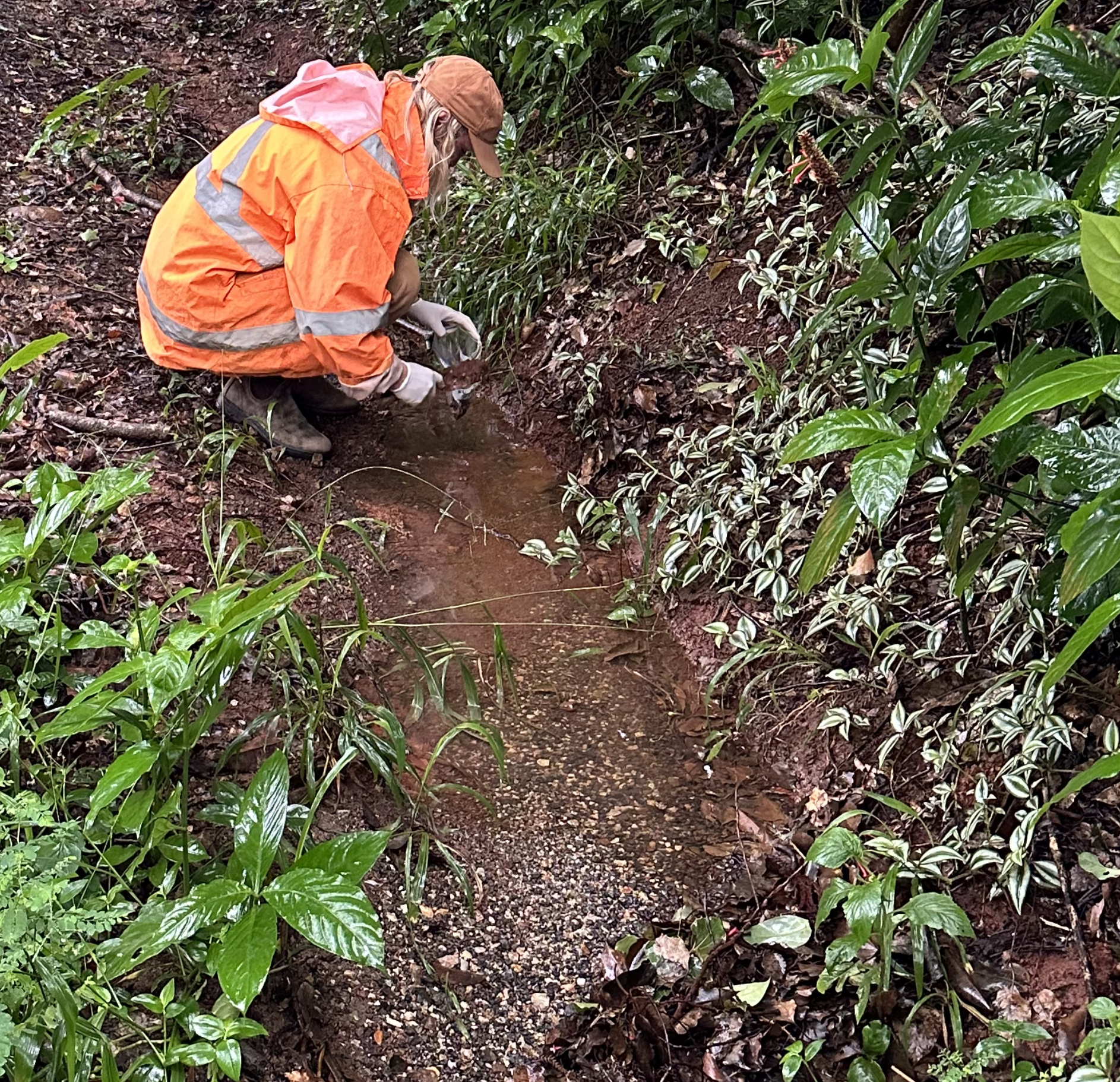
The green hills and coastal sands of the Ballina and Byron Shires carry a history most people never see. A century of cattle dips, banana slopes, cane fields, sand mining and fuel storage has left a chemical memory in some of our soils, sediments and groundwater.
Most residents will never meet a problem. But when land is bought, subdivided, built on, gardened or turned from farm to family home, that history matters: for your family's health, for your investment, and for your development approval.
The ground remembers
Many of the chemicals used on Northern Rivers land were chosen precisely because they lasted. Decades later, many of them are still there.
Cattle tick dips – arsenic, DDT and other organochlorines. Arsenic is an element and never breaks down. It was used in dips until 1955, and DDT until 1962.
Banana plantations – arsenic, dieldrin, heptachlor, DDT and lead. Dieldrin concentrates in the top 75 mm of soil, the same layer children play in and vegetables grow in.
Cane and floodplain cropping – organochlorines, herbicides, cadmium and acid sulfate soils. Residues persist in soils and drain sediments, and disturbed acid sulfate soils release acid and metals.
Orchards and market gardens – lead arsenate, mercury, copper and organochlorines from older, persistent metal-based sprays.
Heavy mineral sand mining – thorium and uranium in monazite-rich residues. Thorium-232 has a half-life of 14 billion years. It will not decay away; it has to be found and managed.
Fuel tanks, workshops and dry cleaners – petroleum hydrocarbons, benzene and chlorinated solvents. Benzene and vinyl chloride are known human carcinogens, and vapours can enter buildings.
Older homes and sheds – asbestos, lead paint and chlordane. Buildings constructed before 1990 are likely to contain asbestos, and termite chemicals persist around old footings.
Imported fill and firefighting foam – mixed waste, asbestos and PFAS. PFAS, the "forever chemicals", resist breakdown and build up in people and animals.
The scale is real. NSW DPI records 1,648 cattle dip sites across the far North Coast, many now on lifestyle and residential blocks. Of the 254 that have been demolished, 29 now have homes built over them.
Why children are most at risk
Children are the reason residential contamination criteria are set as carefully as they are.
Young children play on the ground, put hands and toys in their mouths and weigh far less than adults, while their brains and organs are still developing. National guidance (the ASC NEPM) assumes a small child swallows about 100 mg of soil and dust every day, twice the adult figure.
The consequences depend on the chemical. Lead harms children's brain development, with no known safe level. Arsenic is a known human carcinogen. Persistent, fat-soluble chemicals such as DDT and dieldrin move up the food chain, so an egg from a backyard hen can hold more DDT than the soil it scratched in.
The dose makes the poison, but persistence decides how long the dose is there.
For families on former farmland, the everyday parts of rural life, such as a vegetable patch, free-range chooks, a sandpit or bore water, are exactly the pathways that matter most.
Hazard is not the same as risk
A chemical in the ground is only a health risk if it can reach someone. Environmental health scientists look at every site as a source, a pathway and a receptor. If any link is broken, the risk falls away.
That is why expert interpretation matters more than a single lab number. A contaminated patch sealed under a concrete slab may pose less risk than a smaller amount in a vegetable bed. People can be exposed by swallowing soil and dust, eating home-grown food, breathing vapours or fibres, drinking bore, dam or tank water, through skin contact, or from radiation over mineral sand residues.
Our landscape also moves contaminants further than drier country does. High subtropical rainfall, shallow water tables on the coastal sand plains and major floods such as those in 2017 and 2022 can carry contaminants beyond where they started.
Why councils require it
In NSW, councils must be satisfied that land is suitable for its proposed use, or can be made suitable, before approving a rezoning or development. This is required under Chapter 4 of State Environmental Planning Policy (Resilience and Hazards) 2021.
Locally, the requirements are specific:
Byron Shire Council requires a Contaminated Land Summary Table with every contamination report, and specialist investigation of land that may have been sand mined.
Ballina Shire Council applies Policy C12 Management of Contaminated Land (adopted March 2024).
Both councils take part in the Northern Rivers Contaminated Land Program, supported by the NSW EPA.
A clear, well-prepared Preliminary Site Investigation (PSI) gives council the evidence it needs to assess your application with confidence. That means fewer requests for information, fewer delays and a smoother path to approval. Most sites are cleared at this first stage.
A clean planning certificate is not a clean bill of health
Many landowners assume that if their section 10.7 planning certificate shows no contamination notation, the land is fine. It only records contamination council already knows about.
Most old dip sites, banana slopes and farm fuel tanks have never been investigated. A certificate with no notation tells you very little about the ground itself.
Why it makes sense for homeowners and buyers
Protect your family's health. Know whether the soil under the vegetable garden, the chook run or the children's play area is safe, and whether your bore or dam water is fit to use.
Know before you buy. Understanding the land before settlement protects your negotiating position and helps you avoid inheriting an unexpected clean-up.
Design around it, not over it. Early investigation lets a subdivision or building layout avoid or manage affected areas from the start, rather than discovering them mid-construction.
Avoid unnecessary costs. Testing matched to your site's history means you pay only for analysis that answers your question. The red basalt soils of the plateau naturally carry elevated chromium, nickel and manganese, and telling natural background apart from contamination can save an unnecessary clean-up.
Renovate safely. Asbestos fibres and lead dust cause harm when disturbed. Asbestos-related diseases typically appear 20 to 50 years after exposure.
Protect your property's value. A documented, science-based assessment gives future buyers, lenders and councils confidence in your land.
Does your property need an assessment?
An assessment is worth considering if any of these apply:
You are subdividing, rezoning or changing rural or industrial land to housing, a school, childcare or aged care.
The land was ever a banana plantation, orchard, cane farm, dairy or cattle dip site, or was sand mined.
There is, or was, a fuel tank, workshop, depot, dry cleaner, tip or railway siding on or next to the site.
Council has asked for a Preliminary Site Investigation, or your planning certificate carries a contamination notation.
You are buying rural or commercial land and want to understand the risk before settlement.
Old buildings, imported fill or buried waste are present.
You plan to grow food, keep chickens or drink bore or dam water on land with any of these histories.
Why work with an environmental health scientist
Contamination is ultimately a public health question. At Byron Environmental Consulting, every investigation is framed around one outcome: land that is safe for the people who will live, work and play on it.
We bring local knowledge of Northern Rivers land-use history, reports prepared to Byron and Ballina Shire Council requirements, analysis through NATA-accredited laboratories, and collaboration with NSW EPA-accredited site auditors where independent review is required. Our approach is proportionate: we answer your question without unnecessary cost.
For families concerned about exposures inside the home, such as renovation dust, water quality and building materials, our Children's Environmental Health assessments apply the same science to the places children live and play.
Frequently asked questions
What is a Preliminary Site Investigation (PSI)?
A PSI is the first stage of a contaminated land assessment. It reviews a site's history and current condition to determine whether contamination is likely and whether the land is suitable for its proposed use. Many sites are cleared at this stage.
Does council require contamination testing for my DA?
Councils must consider contamination for every development application and rezoning. A PSI is commonly requested where land has a history of agriculture, fuel storage, industry or sand mining, or where land is changing to a more sensitive use such as housing or childcare.
My land looks clean. Can it still be contaminated?
Yes. Arsenic, organochlorine pesticides, radioactive sand residues and buried waste are invisible at the surface. Concrete dip baths and plantation rows may be long gone, but their chemical legacy can remain for decades.
Will a contamination finding stop my development?
Rarely. Most sites are cleared at the preliminary stage, and where contamination is found it can usually be managed so the land is suitable for its proposed use. Finding it early gives you the most options and the lowest cost.
Is contamination common in the Northern Rivers?
Most residents will never encounter a problem. Contamination tends to be localised to specific former land uses, which is exactly why understanding your site's history is so valuable.
Talk to us about your land
Good investigation today means healthy homes, gardens and waterways tomorrow. Whether you are lodging a DA, buying a rural property or simply want peace of mind for your family, we can help you understand your land.
Taisa Baars · Environmental Health Scientist · Principal
0428 480 511 · taisa@byronenvironmental.com.au · Arrange a quote
We acknowledge the Traditional Custodians of the land and waterways of the Northern Rivers. We pay our respects to Elders past, present and emerging and recognise their continuing connection to Country.