Category: LUCRA & Rural Development
Author: Taisa Baars, Environmental Health Scientist
When homes and rural development move closer to farms, quarries, waste facilities, intensive agriculture or other established activities, the potential for land use conflict needs to be considered early.
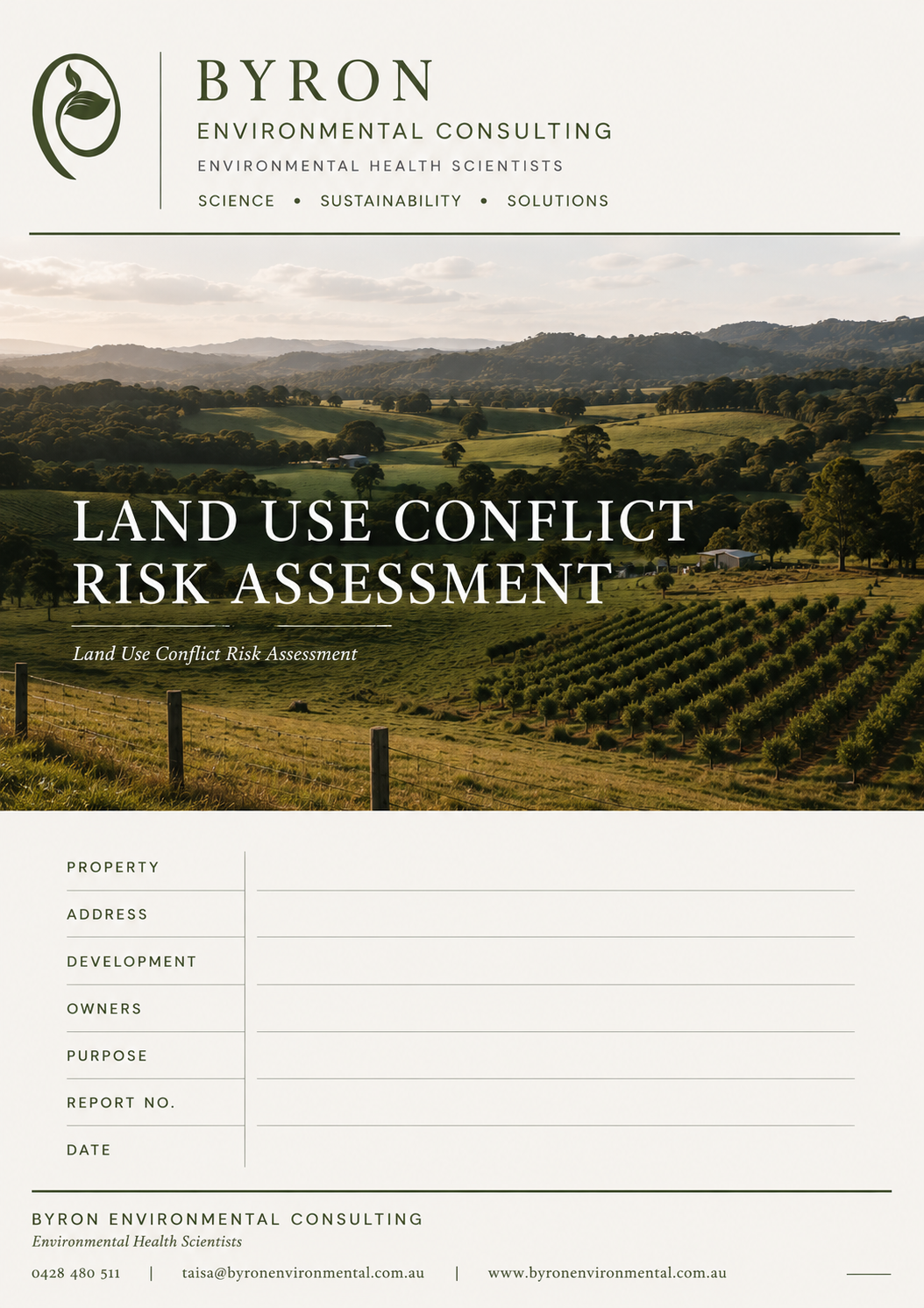
A Land Use Conflict Risk Assessment, commonly called a LUCRA, is a site-specific assessment used to identify these potential conflicts and determine whether they can be avoided or appropriately managed.
A LUCRA is not simply a standard buffer-distance check. It considers how the proposed development and surrounding land uses actually relate to one another.
When might Council request a LUCRA?
Council may request a LUCRA when a proposed development could introduce a sensitive land use—such as a dwelling, subdivision, tourist accommodation or childcare facility—near an existing rural, industrial or infrastructure activity.
This can include development near:
agricultural operations;
cattle yards or intensive livestock activities;
horticulture and spray areas;
quarries and extractive industries;
waste facilities and landfills;
industrial premises;
transport routes; or
other activities capable of producing noise, odour, dust, traffic or visual impacts.
A LUCRA may be requested with the original Development Application or later through a Council Request for Information.
What does a LUCRA assess?
Every assessment is different because the potential conflicts depend on the site, surrounding activities and proposed development.
A LUCRA will generally consider:
the nature and intensity of neighbouring land uses;
separation distances;
odour, noise, dust and other potential impacts;
operating hours and vehicle movements;
prevailing winds;
topography and drainage;
existing vegetation and landform;
the location of proposed dwellings and outdoor areas;
potential changes to surrounding operations over time; and
practical measures that can reduce the likelihood of future conflict.
A site inspection is particularly valuable. Mapping can show distances and property boundaries, but it does not always reveal ridgelines, drainage corridors, lines of sight, vegetation or how an adjoining activity is experienced on the ground.
Why does the dwelling location matter?
On large rural properties, moving a proposed dwelling envelope can be one of the most effective ways to reduce land use conflict.
A suitable location may provide:
greater separation from the adjoining activity;
screening from intervening landform;
less direct exposure to noise, dust or odour;
reduced interaction with heavy vehicles; and
better orientation of bedrooms and outdoor living areas.
The preferred location must also be coordinated with ecological, bushfire, geotechnical, access and on-site wastewater requirements. A good outcome usually comes from the relevant consultants working together rather than assessing each constraint in isolation.
Vegetation helps—but it is not the whole solution
Existing vegetation and additional native planting can provide useful visual screening and may assist with dust and windblown litter.
However, vegetation should generally be treated as a supplementary measure. It does not replace adequate physical separation, appropriate dwelling positioning or effective management of the adjoining activity.
The purpose is coexistence
The aim of a LUCRA is not to suggest that established rural or infrastructure activities should be invisible or completely imperceptible.
It is to determine whether a proposed development can coexist with those activities without exposing future residents to unreasonable impacts or creating complaints that could constrain the continued lawful operation of neighbouring land.
A well-prepared LUCRA gives Council and the project team a clear understanding of:
the potential conflict pathways;
the level of risk;
the most suitable development location; and
the measures required to achieve a practical and supportable outcome.
Byron Environmental Consulting prepares site-specific Land Use Conflict Risk Assessments for rural properties, subdivisions and development projects throughout the Northern Rivers and surrounding NSW regions.
What makes our LUCRA approach different?
A LUCRA should do more than reproduce planning controls and measure a buffer on a map.
Byron Environmental Consulting combines environmental health science, site investigation and practical knowledge of Council assessment requirements. Each assessment considers how potential impacts—including odour, noise, dust, traffic and other environmental nuisances—may actually move through and affect the site.
You work directly with Environmental Health Scientist Taisa Baars throughout the assessment. Where appropriate, the LUCRA also identifies practical dwelling locations and mitigation measures that can be coordinated with the project’s planner, ecologist, bushfire consultant and other specialists.
The result is an independent, site-specific assessment that is technically sound, clearly communicated and useful to both the project team and Council.
Need a LUCRA or received a Request for Information from Council?
Contact Environmental Health Scientist Taisa Baars to discuss your site and Council requirements.
0428 480 511
taisa@byronenvironmental.com.au